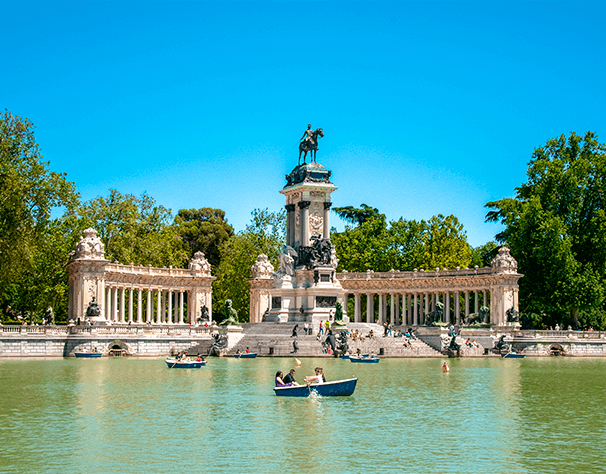
Madrid is a city of grand avenues, elegant plazas and world-class museums, right in the heart of Spain. As the national capital and main transport hub, it brings together high-speed trains, major motorways and Adolfo Suárez Madrid–Barajas Airport, making it a practical starting point if you want to explore central Spain – or even cross the country from north to south.
In the city centre you will find the famous Art Walk, linking the Prado, Reina Sofía and Thyssen-Bornemisza museums; wide boulevards such as Paseo del Prado and Gran Vía; and the royal quarter around the Royal Palace, Almudena Cathedral and Plaza Mayor. Lively neighbourhoods like La Latina, Chueca and Malasaña offer late-night tapas, trendy bars and authentic local restaurants.
Beyond the centre, the wider region rewards anyone who enjoys driving. Within easy reach you have medieval hill towns such as Toledo, Segovia and Ávila, university cities like Salamanca, mountain landscapes in the Sierra de Guadarrama and renowned wine regions, including Ribera del Duero and, further north, La Rioja.
This is where car hire really adds value. Madrid’s historic core is compact and well served by Metro, buses and suburban trains, so you can move around the centre easily without a vehicle. But if you want the freedom to design your own itinerary, leave the city at the time that suits you and reach places that public transport misses, a hire car gives you the mobility, autonomy and convenience that many travellers look for.
Car hire in Madrid is straightforward. International and Spanish brands share space with reliable local companies at Madrid–Barajas Airport and at the main rail stations (Atocha and Chamartín), as well as in selected city districts. Fleets are modern and frequently renewed to comply with low-emission regulations, offering a wide choice of economy and compact cars for city-to-city journeys, plus SUVs, MPVs/people carriers, 7–9-seater minibuses and luxury/executive classes for families, groups and business travellers.
Whether you are flying in for meetings in the financial district, planning a cultural weekend with a couple of day trips, or preparing a longer road trip across central Spain, starting your journey with a hire car in Madrid helps you travel at your own pace, with the security and flexibility to adapt plans as you go.
Why hire a car in Madrid, Spain?
Flexibility beyond the city
Public transport in Madrid is efficient for central journeys, but it quickly becomes less convenient once you head into the surrounding region. Trains to places like Toledo, Segovia or Ávila are relatively frequent, yet they tie you to fixed timetables and stations that are often a walk away from the most scenic areas.
With a hire car you can:
-
Combine several destinations in a single day (for example, Segovia and La Granja, or Ávila and Salamanca).
-
Stop at viewpoints, small villages, countryside restaurants and vineyards that coaches and trains do not reach.
-
Adjust your route easily for weather, queues, roadworks or last-minute recommendations from locals.
For many visitors, car hire turns a simple Madrid city break into a richer driving experience through Castile’s landscapes and historic towns.
A strategic base for road trips
Madrid sits at the crossroads of Spain’s motorway network, with dual carriageways radiating towards almost every region of the country. This makes it a practical base if you are planning a longer itinerary, such as:
-
A loop through Castile and León, taking in Segovia, Ávila, Salamanca and Valladolid.
-
A food-and-wine route through Ribera del Duero, continuing north towards La Rioja.
-
A journey south towards Andalusia, perhaps stopping in Córdoba or Granada on the way.
When you share the cost of car hire across several travellers, especially families or groups carrying substantial luggage or sports equipment, driving often offers excellent value for money compared with multiple long-distance train tickets.
Seasonality, events and busy periods
Madrid welcomes visitors all year, with steady demand and clear peaks during:
-
Holy Week (Semana Santa) – when processions and temporary road closures in the historic centre affect bus routes and taxi availability.
-
Summer (July–August) – very warm in the city, encouraging day trips to the mountains or cooler towns.
-
Major events – large trade fairs at IFEMA, international conferences and big football matches at Santiago Bernabéu or Cívitas Metropolitano, all of which can put pressure on public transport and ride-hailing.
In these busier moments, hiring a car can give you more control over arrival and departure times, particularly for early-morning or late-night airport transfers, or when you are moving between several venues in a single day.
Balancing car hire with low-emission zones
Madrid operates a comprehensive low-emission scheme known as Madrid 360 / Madrid ZBE. The entire municipality is a low-emission zone, with stricter rules in the Special Protection Low Emission Zone (ZBEDEP Distrito Centro), which covers much of the historic centre around Sol, Gran Vía, La Latina and nearby districts.
The smartest strategy for many travellers is to:
-
Use public transport, walking and taxis within the dense historic core, where everything is close together.
-
Use your hire car mainly for regional excursions and intercity travel, where driving saves most time and offers the greatest freedom.
This balanced approach lets you enjoy the convenience of a hire car without unnecessary stress in narrow streets, while still making the most of Madrid’s excellent public transport for short hops.
Choosing the right vehicle class
Madrid’s car hire market covers everything from compact city cars to premium executive models and 7–9-seater minibuses. The best choice depends on your group size, the amount of luggage you carry and how far you plan to drive.
Couples and solo travellers on city breaks
If you are mainly staying in central Madrid with one or two day trips:
-
Economy or supermini/hatchback – Ideal if you travel light and are comfortable with a smaller vehicle. These classes are easier to manoeuvre into tight spaces in town car parks in Toledo or Segovia, and are usually the most economical in terms of price and petrol consumption.
-
Compact – A good balance of interior space and agility, especially if you expect to spend more time on motorways than in very narrow streets.
These vehicles are perfectly comfortable for journeys of one to two hours to nearby cities and scenic areas.
Families with children
For families, comfort and boot space become more important:
-
Compact or mid-size saloon – Suitable for a small family with a couple of medium suitcases and a pushchair.
-
Estate – Extra boot capacity for larger luggage, fold-up cots or sports equipment, while remaining stable and comfortable at motorway speeds.
-
SUV/4x4 – Popular with families who value a higher driving position, flexible seating and good ground clearance. Particularly convenient if you intend to visit the Sierra de Guadarrama or rural areas, where roads can be steeper and conditions change quickly in cooler months.
If you need child seats, reserve them in advance during booking and allow some extra time at the counter to fit them correctly and safely before you drive away.
Groups of friends and extended families
For three or more adults with luggage, moving up a class can make journeys much more comfortable:
-
MPV/people carrier – Versatile seating and generous luggage space, ideal for up to five people travelling together on multi-day road trips.
-
7–9-seater/minibus – A practical option for larger groups heading to events, football matches or countryside villas. This can be especially cost-effective compared with booking several taxis or train tickets, though you should always check any height or length limits at the car park you plan to use.
Bear in mind that bigger vehicles may be less convenient in very narrow streets or small underground car parks, so it helps to plan where you will park in each town.
Business travellers
If you are visiting Madrid for work, attending meetings or combining several cities in one trip:
-
Saloon – Professional, comfortable and well suited to frequent motorway driving between cities such as Madrid, Toledo and Valladolid.
-
Luxury/executive – A good choice for senior executives or occasions where image is important, such as client visits in the financial district or conference centres.
Many business travellers prefer a hire car with an automatic gearbox to reduce fatigue in traffic and on multi-lane junctions around the ring roads.
Countryside explorers and wine-region visitors
If your main goal is to enjoy national parks, mountain areas or wine regions:
-
SUV/4x4 – Often the most versatile option, offering good ground clearance for rural car parks and access roads in the Sierra de Guadarrama.
-
Estate – Excellent if you carry bulky outdoor gear or several cases of wine, while remaining efficient on long motorway stretches.
Roads in the hills near Madrid are generally paved and in good condition, so you rarely need specialist off-road vehicles. Focus instead on comfort, luggage capacity and a class that matches your itinerary.
What to do in Madrid, Spain
A hire car is not essential inside central Madrid, but it greatly expands what you can see around the region. Below are some of the top excursions where driving offers clear convenience and freedom.
1. Toledo – medieval city on a hill
Toledo is a UNESCO-listed city perched on a hill above the River Tagus, celebrated for its cathedral, synagogues, churches and centuries of intertwined Christian, Jewish and Muslim heritage.
With a hire car you can:
-
Drive directly from Madrid to Toledo without relying on fixed train times.
-
Park in one of the car parks on the outskirts and use escalators or short walks to reach the old town, avoiding steep uphill climbs with luggage.
-
Continue to viewpoints such as Mirador del Valle, which offers superb panoramic views of the city and river, and is difficult to reach comfortably by public transport.
2. Segovia and La Granja – aqueduct, fortress and royal gardens
-
Distance: ~90 km Madrid–Segovia, then ~13 km Segovia–La Granja
-
Typical driving time: Around 1 hour 15 minutes to Segovia via A-6 and AP-61
Segovia’s Roman aqueduct and fairy-tale Alcázar fortress make it one of Spain’s most striking day trips. Just beyond lies the Royal Palace of La Granja de San Ildefonso, with formal gardens and fountains backed by the Sierra de Guadarrama.
A hire car allows you to:
-
Combine Segovia and La Granja in a relaxed loop of roughly 220 km.
-
Park on the edge of Segovia’s historic area and stroll into the centre, then continue by car to La Granja when you are ready.
-
Stop spontaneously at viewpoints or small villages in the Sierra de Guadarrama, where bus services are infrequent.
3. Ávila and Salamanca – city walls and university cloisters
-
Distance: ~110 km Madrid–Ávila, then ~100 km Ávila–Salamanca
-
Typical driving time: About 1 hour 20 minutes to Ávila via A-6 and AP-51; around 1 hour Ávila–Salamanca via A-50
Ávila is famous for its remarkably intact medieval walls, while Salamanca is a golden-stone university city with elegant squares, twin cathedrals and historic colleges.
With a hire car you can:
-
Visit both cities in one extended day if you start early, or stay overnight without worrying about return train times.
-
Choose your own route, stopping at smaller Castilian towns and viewpoints for lunch or coffee.
-
Move luggage easily between hotels if you decide to split your stay between Ávila and Salamanca.
4. Wine country – Ribera del Duero and beyond
For food and wine enthusiasts, Madrid is a gateway to some of Spain’s most respected wine regions. Vineyards and villages are widely dispersed, which is exactly where a hire car is most useful.
Benefits of driving include:
-
Reaching individual wineries (bodegas) that have little or no public transport.
-
Linking several villages, viewpoints and lunch stops in a single itinerary.
-
Returning easily to Madrid or continuing on to other regions when it suits your schedule.
If you are planning tastings, always arrange a designated driver in your group or limit your tastings to remain safely within legal drink-driving limits.
5. Sierra de Guadarrama and Navacerrada – mountains and fresh air
-
Distance: ~60–75 km north-west of Madrid
-
Typical driving time: Around 1 hour via A-6, depending on the valley you choose
The Sierra de Guadarrama offers cooler temperatures in summer and snow in winter, with lakes, walking routes and viewpoints spread across different valleys.
With a hire car:
-
You can reach several starting points for walks, picnic areas and lakes in one day.
-
Families can pack picnics, pushchairs and extra layers in the boot without worrying about crowded trains or bus luggage limits.
-
Winter visitors can access snow areas when conditions allow, and adjust plans quickly if the weather changes.
Public transport does reach some parts of the mountains, but frequencies and routes are limited compared with the flexibility of driving yourself.
Driving conditions
Driving in and around Madrid is generally straightforward, with well-maintained roads and clear signage. A little preparation will help you feel more confident and keep your trip smooth and safe.
Low-emission zones and environmental stickers
The entire municipality of Madrid forms a low-emission zone (ZBE) under the Madrid 360 scheme. Within it, there are stricter Special Protection Low Emission Zones, such as ZBEDEP Distrito Centro and Plaza Elíptica, which cover much of the historic centre and some busy junctions.
Key points:
-
Vehicles in Spain are classified with a DGT environmental sticker: A (no sticker), B, C, ECO and ZERO.
-
Modern hire cars in Madrid almost always carry at least a C sticker, and many are ECO or hybrid.
-
Vehicles without a sticker (A) are being progressively banned from circulating in the capital.
-
Entering restricted streets or zones without the correct rights can result in camera-enforced fines of around EUR 200.
Practical advice:
-
Confirm that your hire car has an appropriate DGT sticker at pick-up.
-
Avoid driving into the historic centre around Sol, Gran Vía, La Latina and Barrio de las Letras unless you are sure your route and chosen car park are permitted.
-
Use navigation tools and set preferences to avoid low-emission restrictions where possible.
Many visitors prefer to park outside the strict core and continue by Metro, bus or on foot for central sightseeing.
Traffic patterns and journey times
Madrid’s main rush-hour peaks are:
Busy areas include:
-
The M-30 and M-40 ring roads and radial routes (A-2, A-3, A-4, A-5, A-6) during commuting periods.
-
Roads around Adolfo Suárez Madrid–Barajas Airport and IFEMA during large trade fairs.
-
Areas near football stadiums before and after major matches.
Approximate journey times in normal conditions:
-
Madrid–Toledo: ~1 hour
-
Madrid–Segovia: ~1 hour 15 minutes
-
Madrid–Ávila: ~1 hour 20 minutes
-
Madrid–Ribera del Duero (selected areas): 1.5–2 hours
Always allow extra time during rush hours, holiday weekends or major event days, especially when returning your hire car to the airport.
Parking
Central Madrid combines underground car parks, controlled on-street zones and a network of restricted streets.
General tips:
-
Plan your car park in advance if you intend to drive near the historic centre. Many underground car parks are accessible but may require you to pass ZBE signs, so check that your chosen route is authorised.
-
In older districts such as La Latina, Malasaña and Lavapiés, streets are narrow and busy. Using a multi-storey car park on the edge of the neighbourhood and walking in is usually simpler than trying to park on-street.
-
In popular day-trip towns like Toledo, Segovia and Ávila, look for clearly signed visitor car parks just outside the old walls and walk up to the historic core.
When parking on-street, pay attention to colour-coded bays, time limits and payment machines. Keep valuables out of sight in the boot and take important documents with you.
Road quality, tolls and service areas
Intercity roads from Madrid are mostly modern dual carriageways and motorways:
-
Road surfaces are generally high quality, with good lighting, clear markings and frequent service areas.
-
Some longer routes include toll roads, usually as an optional alternative to untolled dual carriageways. They can save time on busy days or during holiday periods.
-
Tolls can normally be paid with cash or a standard payment card; charges vary by distance and route.
Petrol stations are plentiful around Madrid and along main routes, making it easy to refuel before returning your hire car.
Weather and seasonal driving
Madrid has a continental climate:
-
Summer: Hot, especially in the afternoon. Air conditioning in your hire car makes journeys more comfortable, and many drivers prefer morning or evening travel to avoid the highest temperatures.
-
Winter: Cool in the city and colder in the surrounding mountains. Snow is not frequent in central Madrid, but the Sierra de Guadarrama can see snow, ice and occasional road closures.
If you plan winter trips to higher altitudes:
-
Check the forecast and any road alerts before setting off.
-
Be aware of the risk of black ice on shaded or elevated sections.
-
Follow local advice regarding snow chains, winter tyres (where required) and temporary access restrictions.
Practical driving tips for visitors
-
Documents: Bring your driving licence and passport or national ID. Many non-EU visitors can drive using their national licence if it is in Roman alphabet; some may require an International Driving Permit, so check before you travel.
-
Age rules: Many providers set a minimum driving age of around 21–23 years, sometimes with a young-driver surcharge for those under 25. Requirements vary by company and vehicle class.
-
Gearbox choice: Manual gearboxes are common in Spain. If you prefer an automatic gearbox, select this specifically during booking, as availability can be limited.
-
Mobile phone use: Using a mobile phone while driving is prohibited unless it is completely hands-free. Set your navigation and playlist before you move off.
-
Speed limits: Typical limits (unless signs indicate otherwise) are around 120 km/h on motorways, 90 km/h on many rural roads and 30–50 km/h in urban areas, with stricter limits in traffic-calmed streets and near schools.
-
Navigation: Consider downloading offline maps using airport or hotel Wi-Fi, so you can navigate confidently even if your mobile data signal drops.
-
Vehicle check: When you collect your hire car, walk around it carefully, take date-stamped photos of any existing marks or scratches, and check that the fuel level and mileage match the paperwork. Inside, familiarise yourself with lights, indicators, mirrors and climate controls before joining traffic.
By understanding Madrid’s low-emission rules, planning your parking and choosing the right vehicle class for your needs, you can enjoy the capital’s cultural highlights and still have the freedom, safety and convenience to explore Spain’s historic cities, vineyards and mountain landscapes at your own pace with a hire car.
 My Account
 My Bookings
 RentRewards
 Deals
Deals
 Log Out
 Quick and easy booking process